




President Donald Trump announced Sunday that senior US officials are heading to Islamabad, Pakistan for a second round of peace negotiations with Iran. Within hours, Tehran fired back — refusing to participate and closing the Strait of Hormuz again. What was supposed to be a diplomatic breakthrough has turned into one of the most tense 24-hour stretches of the entire war.
Trump’s Announcement: Islamabad, Tomorrow Night
On Sunday, President Trump confirmed publicly what had been rumoured for days — US negotiators are returning to Pakistan for another round of talks.
Trump said on Truth Social that government representatives are going to Islamabad, Pakistan for another round of negotiations with Iran. He told Fox News that special envoy Steve Witkoff is on his way to Islamabad, and that his son-in-law Jared Kushner would also take part in the negotiations. CBS News
The three US officials heading to Pakistan are Vice President JD Vance, special envoy Steve Witkoff, and Jared Kushner, according to a White House official. The trio are expected to arrive Monday evening for talks on Tuesday. NPR
Trump was in characteristically confident form about the prospects. Trump told Axios on Sunday that he is optimistic about the talks with Iran. “I feel fine about it. The concept of the deal is done. I think we have a very good chance to get it completed,” he said. The Jerusalem Post
Iran’s Response: We’re Not Coming
Just hours after Trump’s announcement, Tehran threw cold water on the entire plan.
Iran rejected taking part in the second round of talks with the United States. “Iran stated that its absence from the second round of talks stems from Washington’s excessive demands, unrealistic expectations, constant shifts in stance, repeated contradictions, and the ongoing naval blockade, which it considers a breach of the ceasefire,” Iran’s official news agency IRNA said. Iran also accused the US of playing a “blame game,” lying about Iran’s participation in order to put pressure on the country. The Jerusalem Post
Trump’s announcement of talks came after Iranian officials said they had reversed the reopening of the Strait of Hormuz and reimposed restrictions on the vital shipping lane after the US said it would not end its blockade of Iranian ports. The Irish Times
So the situation on Sunday evening stands at this: the US delegation is heading to Islamabad. Iran says it will not be there. The Strait of Hormuz is closed again. And the two-week ceasefire expires Tuesday.
What Triggered This — The Strait of Hormuz Standoff
To understand why talks collapsed before they even began a second time, you need to understand the standoff over the Strait of Hormuz — the narrow waterway through which roughly 20% of the world’s oil and gas passes.
Trump blasted Iran for what he said was a “total violation of our ceasefire agreement,” after Iranian forces fired on two vessels attempting to traverse the Strait of Hormuz on Saturday. CBS News
Iran briefly announced on Friday that it was reopening the strait — a move Trump publicly celebrated. But that lasted less than 24 hours. Iran’s National Security Council stated that Iran is “determined to exercise supervision and control over traffic through the Strait of Hormuz until the war is definitively ended and lasting peace is achieved in the region.” NPR
The US, for its part, has maintained its naval blockade of Iranian ports — which Iran considers a ceasefire violation in itself. Both sides are accusing each other of breaking the terms of the deal, and neither is backing down.
The US military said it forced 23 ships to turn around as part of its blockade of Iranian ports. The US has also seized an Iranian-flagged cargo ship in the Strait of Hormuz after firing on its engine room, Trump confirmed in a social media post. NPR
Pakistan Is Still Working the Phones
While the two sides are publicly trading accusations, Pakistan has not given up on bridging the gap behind the scenes.
Pakistani Field Marshal Asim Munir, the key interlocutor between the two countries, arrived in Tehran for meetings with Iranian diplomats. His presence, along with Pakistani Interior Minister Mohsin Naqvi, shows the level of diplomatic clout that Islamabad is wielding in an attempt to persuade Tehran to come back to the negotiating table. CNN
Iran’s Supreme National Security Council said in a statement that Pakistan’s army chief, serving as an intermediary, presented proposals to Iran during his recent visit to Tehran, and that they were still under review. Iran has yet to formally respond, but further talks would require the US to meet certain conditions. CNBC
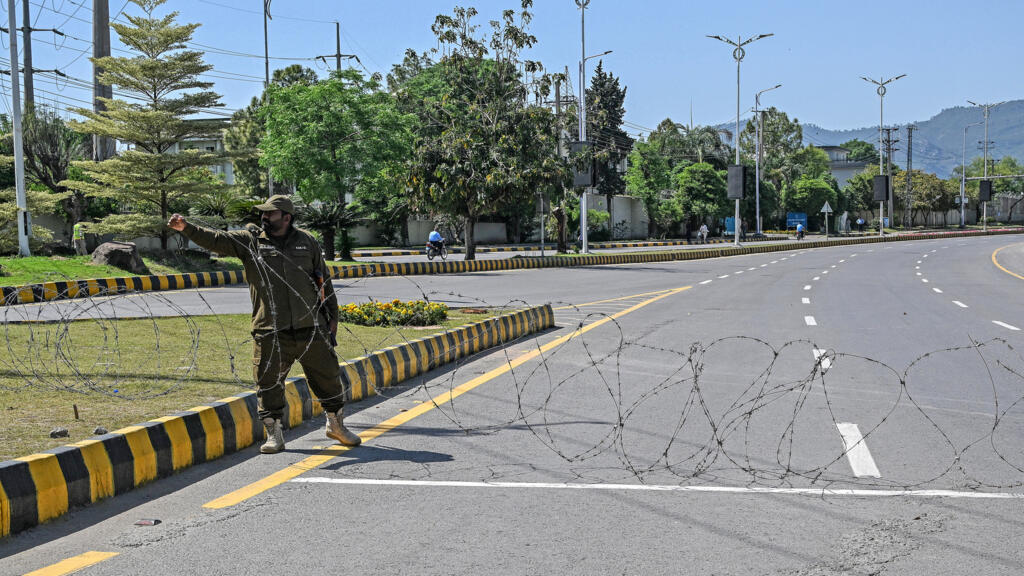
Islamabad is also preparing for the possibility that the talks could still happen — even at the last minute. Security in Pakistan’s capital was stepped up visibly on Sunday ahead of upcoming peace talks. Authorities announced road closures and traffic restrictions across the city, as well as in neighbouring Rawalpindi. Armed guards and checkpoints appeared near Islamabad’s most secure hotels, including the Marriott and the Serena, where the last round of talks took place. Most streets leading to the Serena Hotel were closed, with barbed wire, barricades, and heavy security visible. CBS News
Islamabad is ready. Whether both delegations actually walk through the door is another question entirely.
Are the Right People Even at the Table?
As the world watches this diplomatic high-wire act, a separate and uncomfortable debate has been unfolding in Washington — one that questions whether the US is sending the right team to negotiate a deal of this magnitude.
Former diplomats have raised serious concerns about whether Kushner and Witkoff, who led the Iran negotiations with VP Vance, lack the expertise and diplomatic experience needed to secure an agreement. “Iran and the US under Kushner and Witkoff? Failure. They get an F in diplomacy,” said Aaron David Miller, a former US State Department Middle East negotiator who served six secretaries of state. Time
David Satterfield, a former US Ambassador to Turkey and a career diplomat for four decades, warned: “Not only does the US need to make clear what its goals were, and to know internally where it was prepared to concede, and where it was not prepared to concede, where the line would be held — the red lines — but to have a realistic sense of what the other side was bringing with it.” Time
The White House has defended its team, noting that Witkoff and Kushner successfully brokered the Israel-Hamas ceasefire. But Iran is a fundamentally different negotiating challenge — one with a nuclear dimension, a sovereign pride streak, and decades of accumulated grievance.
The Ceasefire Expires Tuesday. Then What?
The two-week ceasefire that Pakistan brokered on April 8 expires Tuesday, April 21. That is the hard deadline around which everything this week is being structured.
The two-week US-Iran ceasefire signed this month is set to expire Wednesday. Monday’s talks would mark the second official meeting of US and Iranian diplomats since the war began. Iranian Parliamentary Speaker Mohammad Bagher Ghalibaf said that the US and Iran remain far apart on key issues, including the future of Iran’s nuclear program and control over the Strait of Hormuz, and that Washington will need to rebuild trust for any agreement to hold. Washington Times
The White House said it is optimistic about a possible peace agreement coming into view. “Discussions are being had, and we feel good about the prospects of a deal,” press secretary Karoline Leavitt told reporters, while cautioning that the next round of in-person talks had not yet been made official. Pakistan is “the only mediator in this negotiation,” Leavitt said, praising Islamabad for its help so far. CNBC
If the ceasefire expires without a new framework in place and without both sides returning to the table, the war resumes in full. That outcome — with the Strait of Hormuz closed, oil prices surging, and US naval forces already in position — would carry consequences far beyond the Middle East.
For now, the US Officials is in the air heading to Islamabad. Whether Iran joins them at the table before the clock runs out is the question that the entire world is watching.
External Sources:
- Washington Times — Trump Says US Representatives to Travel to Pakistan
- CBS News — Live Updates: US Officials Traveling to Pakistan
- Jerusalem Post — Iran Rejects Second Round of Talks
- NPR — US Seizes Iranian Cargo Ship in Strait of Hormuz
- TIME — Diplomats Fear Trump’s Iran Envoys Are Making Things Worse