



It was supposed to be the week that diplomacy finally broke through. Iran’s foreign minister was in Islamabad. US envoys were packing their bags. The world held its breath. And then, in a matter of hours, the whole thing fell apart — Trump cancelled the trip, Iran’s diplomat flew home, and the second round of US-Iran peace talks collapsed before it even began.
But even in the wreckage of yet another diplomatic setback, one thing remained constant: President Donald Trump’s praise for Pakistan — and his increasingly sharp warnings for Tehran.
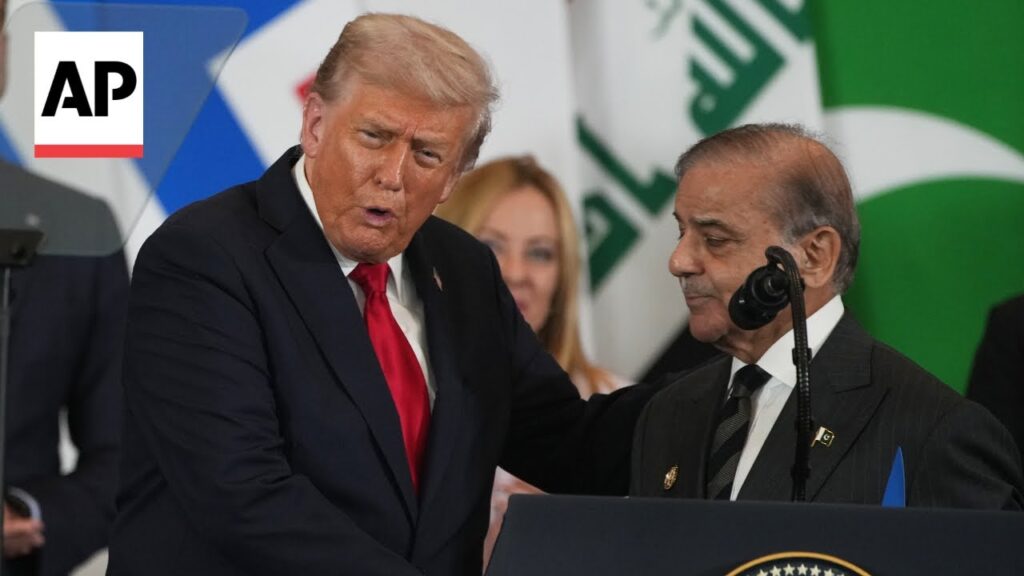
“I think Pakistan is terrific. The field marshal is fantastic. I think the prime minister of Pakistan is great, and, you know, they would like to see something happen,” Trump said in a Fox News interview, referring to Field Marshal Asim Munir and Prime Minister Shehbaz Sharif. “Great respect for Pakistan, but I will, because they’ve been terrific. They’ve really tried, and they’ll stay involved,” he added. Morningstar
For Iran, Trump reserved a very different tone.
Trump responded to the current deadlock in peace talks by warning Iran to “better get smart soon,” posting a mocked-up image of himself on his Truth Social platform holding a gun. “The question is whether or not they’re going to go far enough, so at this moment, there will never be a deal unless they agree that there will be no nuclear weapons,” Trump added from the Oval Office. pakistantoday
The contrast could not be starker: warm words for Islamabad, loaded warnings for Tehran — and a ceasefire that is somehow still holding despite every reason it shouldn’t be.
What Actually Happened: The Collapse of Round Two
The events of April 25 unfolded with a speed and confusion that left diplomats scrambling and markets rattled. For a brief moment, it looked like a second round of direct US-Iran talks in Islamabad was genuinely imminent.
The White House said Friday that a US delegation would travel to Islamabad over the weekend. But Iranian media had denied reports that Foreign Minister Araghchi would directly negotiate with Washington during his trip, leaving the status of talks uncertain. Pakistan Today
Iran’s Araghchi had arrived in Islamabad — but only to speak with Pakistani officials, not with the Americans. The US delegation, led by special envoy Steve Witkoff and Jared Kushner, was preparing to make the 17-plus-hour journey to Pakistan. And then Trump pulled the plug.
President Trump on Saturday cancelled plans to send US special envoy Steve Witkoff and Jared Kushner to Pakistan after Iran’s chief negotiator left Islamabad after speaking only to Pakistani officials. “Too much time wasted on traveling, too much work! Besides which, there is tremendous infighting and confusion within their ‘leadership,'” the president wrote in a post on Truth Social. “Nobody knows who is in charge, including them. Also, we have all the cards; they have none! If they want to talk, all they have to do is call!!!” GovPing
Before boarding Air Force One for a return flight to Washington, Trump said Iran had improved an offer to resolve the conflict after he cancelled the visit, “but not enough.” Theurduclub
The shock was complete. In the space of 24 hours, the diplomatic world went from cautious optimism about a second round of face-to-face talks to a cancelled delegation, a departed Iranian foreign minister, and a US president posting gun imagery online.
Why Pakistan Escaped Without a Scratch
In any other diplomatic crisis, the collapse of talks on a country’s soil might damage that country’s credibility as a mediator. Not this time. Not for Pakistan.
Despite cancelling the visit, Trump appreciated the efforts of Pakistan’s leadership in bringing both sides closer for negotiations and said Pakistani mediators would continue to play a role in the process between Washington and Tehran. He has repeatedly praised Pakistan’s civil and military leadership for helping facilitate talks, including the first round held in Islamabad on April 11. ProPakistani
On April 17, Trump had also praised PM Shehbaz and Field Marshal Munir following what appeared to be a breakthrough when Iran announced it would open the Strait of Hormuz to commercial vessels. In a Truth Social post at the time, he wrote: “Thank you to Pakistan and its great prime minister and field marshal, two fantastic people!” Morningstar
The reason Pakistan’s reputation survived the collapse unscathed is that both Washington and Tehran know what happened. Iran chose not to meet the Americans. The Americans chose not to make the journey. Pakistan — sitting squarely in the middle — did everything it could to make both meetings happen. The failure belonged to the two principals, not the mediator.
Pakistan’s role in bringing the United States and Iran together for high-level talks after weeks of conflict has received global recognition. During the meetings in Islamabad, Field Marshal Asim Munir played a key role in welcoming both delegations and maintaining a positive environment, including interactions with US Vice President JD Vance. Capital.com
The Man Trump Calls “My Favorite Field Marshal”
No figure in this entire saga has emerged more enhanced in stature than Field Marshal Syed Asim Munir — and Trump’s public praise has been relentless and genuine.
Trump has repeatedly praised Munir, calling him an “exceptional man,” a “great fighter,” and “my favorite field marshal.” Pakistani officials and media reports say the two men now speak directly. Pakistani analyst Raza Rumi told Fox News Digital that Munir’s appeal to Trump is not surprising. “Trump has long shown a preference for strong, decisive leaders,” Rumi said. He described Munir as “a disciplined, institution-first leader with a strong emphasis on order, hierarchy and strategic clarity.” Mettis Global
Munir’s background helps explain both his style and his influence. A former head of both Pakistan’s Military Intelligence and Inter-Services Intelligence agencies, Munir spent years overseeing Pakistan’s most sensitive regional relationships, including with Iran, Afghanistan, and India. Mettis Global
Earlier, US Vice President JD Vance also commended Pakistan’s leadership, giving “a lot of credit” to Field Marshal Asim Munir and Prime Minister Shehbaz Sharif for their role in hosting and mediating the talks. Vance noted that both leaders demonstrated “exceptional” hospitality and statesmanship in bringing the parties together despite years of limited high-level engagement between Washington and Tehran. ProPakistani
The relationship between Trump and Munir did not begin with the Iran crisis. Munir’s relationship with Trump dates back to the India–Pakistan crisis of May 2025. Munir played a key role in helping de-escalate that confrontation. Afterward, Pakistan formally nominated Trump for the Nobel Peace Prize — a move widely viewed by Pakistani analysts as encouraged by Munir. Momentumpakistan
According to one prominent Chinese analyst, Munir’s close ties with Trump gave him a unique advantage in de-escalating a conflict that has threatened to shake the global economy. The New York Times reported that shortly before announcing the ceasefire on April 8, Trump made two phone calls: one to Israeli Prime Minister Benjamin Netanyahu, and one to Munir. Momentumpakistan
That detail is extraordinary. The leader of the world’s most powerful military, at the most critical moment of a major conflict, picked up the phone and called Pakistan’s army chief before calling anyone else in the region.
Trump’s Nuclear Red Line — No Deal Without It
While Trump’s praise for Pakistan has been warm and consistent, his message to Iran has sharpened considerably in the wake of the diplomatic setback.
“The blockade is somewhat more effective than the bombing. They are choking like a stuffed pig. And it is going to be worse for them. They can’t have a nuclear weapon,” Trump said in an Oval Office interview. “They want to settle. They don’t want me to keep the blockade. I don’t want to [lift the blockade], because I don’t want them to have a nuclear weapon.” pakistantoday
The nuclear issue has become the absolute non-negotiable core of Washington’s position — and Iran’s latest proposal, which seeks to defer the nuclear discussion until after the war ends, runs directly into this wall.
Pakistan could receive Iran’s revised peace proposal by Friday, sources say, as Trump warned Iran “better get smart soon.” “The question is whether or not they’re going to go far enough, so at this moment, there will never be a deal unless they agree that there will be no nuclear weapons,” Trump told reporters. ProPakistani
White House Press Secretary Karoline Leavitt, pressed on the nuclear question, made Trump’s position clear: “He is satisfied with the naval blockade and he understands that Iran is in a very weak position and the cards are in President Trump’s hands right now.” Bloom Pakistan
Iran’s Internal Divisions: The Real Reason Talks Collapsed
Trump’s Truth Social post blaming “infighting and confusion” within Iran’s leadership was not entirely wrong — and this internal fracture is one of the most important and underreported dimensions of the entire crisis.
Tehran’s top diplomat, Abbas Araghchi, would only engage in bilateral talks with the Pakistani mediation team, Iranian state media repeatedly said. Adding further difficulty was the choice to send Witkoff, who is seen as untrustworthy by Iranian negotiators according to sources familiar with the talks. Whether Trump miscalculated the diplomatic dynamic, or Iran isn’t ready to make the compromises he wants, at least markets stayed in the green after the Friday announcement. Pakistan Today
The divide between Iran’s civilian diplomatic track — represented by Araghchi and President Pezeshkian — and the IRGC’s hardline faction runs deep. The IRGC sets military policy independently and has repeatedly undermined civilian negotiating positions by attacking ships during ceasefire periods. When Araghchi left Islamabad without meeting the Americans, he was not just making a personal decision — he was operating within constraints set by forces that outrank him in Iran’s actual power structure.
Trump wrote on Truth Social at the time of the ceasefire: “Based on the fact that the Government of Iran is seriously fractured, and upon the request of Field Marshal Asim Munir and Prime Minister Shehbaz Sharif of Pakistan, we have been asked to hold our attack.” J.P. Morgan
The fact that Trump used the word “fractured” to describe Iran’s government — and that he explicitly cited Pakistan’s leaders’ personal request as the reason for holding fire — says everything about how high the stakes of this mediation are.
Pakistan’s Next Move: The Revised Proposal
Even after the collapse of the weekend talks, Pakistan has not stepped back from the mediating table. If anything, Islamabad is doubling down.
Pakistan could receive Iran’s revised peace proposal by Friday, sources say. That proposal — expected to be a modified version of the offer Trump called “not enough” — will go through Pakistani channels before being relayed to Washington. Every word, every comma, every concession or condition in that document will first land in Islamabad before it lands in the Oval Office. pakistantoday
Trump said Pakistani mediators would continue to play a role in the process between Washington and Tehran. “If they want to talk, they can come to us, or they can call us. You know, there is a telephone. We have nice, secure lines, but we’re not sending people to travel 18 hours to meet,” he said. Morningstar
That last line contains an implicit message to Tehran: the next round of in-person talks, if they happen, will require Iran to take more initiative. The US has now twice prepared to send its most senior envoys to Pakistan — and twice either cancelled or seen the talks collapse before they began. A third attempt will likely require a clearer prior commitment from Iran that its delegation will actually engage with the Americans directly.
The Blockade Is Tightening — And Costing the World
As diplomacy stalls, the economic pressure being applied through the naval blockade is intensifying — but the costs are not only being borne by Iran.
Traffic in the Strait of Hormuz remains at a screeching halt. Iran has seized ships near the strait, while the United States continues to enforce a blockade of Iranian ports, directing more than thirty vessels to turn around. Iran’s military capabilities are significantly degraded, yet the New York Times estimates that 40 percent of its pre-war drone arsenal and some 60 percent of its missile launcher capabilities are still intact. Parwaaz-psdf
US Defense Secretary Pete Hegseth offered a fiery defence of the war with Iran at a Congressional hearing after a lawmaker called the conflict a “quagmire” the country is “stuck in.” On the war’s costs, Hegseth said any supplemental funding request for the war with Iran specifically would be less than $25 billion, “but there’s a lot more we would ask for beyond just Iran.” Thirteen US service members have been killed to date. ProPakistani
Meanwhile, the human cost on all sides is mounting. Iran’s forensics chief said nearly 3,400 people had been killed in the country since US-Israeli strikes began February 28. Almost 2,500 people have been killed in Lebanon, 32 have been killed in Gulf states, and 23 have died in Israel. Theurduclub
What Happens Now: All Eyes on the Revised Proposal
The diplomatic picture heading into the coming days looks like this: Iran is working on a revised peace proposal that Pakistan will receive and relay to Washington. Trump has set no firm deadline but has made clear that any deal without nuclear commitments from Iran is no deal at all. The ceasefire remains technically in effect — with violations on both sides. The blockade continues. The Strait of Hormuz remains effectively closed. And Pakistan remains the only channel through which Washington and Tehran are still communicating.
For both sides, the clock is ticking. The continued closure of the strait has sent gas prices soaring and could cause further damage to the world economy. Diplomatic efforts to end the Iran war have stalled as both sides dig in on their demands, even as they face mounting pressure to reach a compromise. SPINIDG
Trump, in one of his more measured moments this week, acknowledged the stakes of what Pakistan is doing. “I think Pakistan is terrific… they would like to see something happen,” he said. It was a rare moment of genuine restraint — a recognition that the country standing between the world and a resumption of full-scale war in the Middle East is an ally that deserves not just praise, but results. Daily Pakistan
The Diplomatic Scoreboard: Where Things Stand (April 29, 2026)
| Issue | Current Status |
|---|---|
| US-Iran direct talks (Round 2) | Collapsed — Araghchi left, US cancelled trip |
| Ceasefire status | Technically in force, violations on both sides |
| US naval blockade | Active — 39+ ships redirected |
| Iran’s Strait of Hormuz blockade | Active — closed to most shipping |
| Iran’s nuclear proposal | Defer to after war — US unlikely to accept |
| Revised Iranian proposal | Expected via Pakistan by end of week |
| Trump’s view of Pakistan | “Terrific” — highest praise in any interview |
| Trump’s view of Field Marshal Munir | “Fantastic” / “My favorite field marshal” |
| Trump’s warning to Iran | “Better get smart soon” — nuclear non-negotiable |
| Pakistan’s role going forward | Confirmed — “They’ll stay involved” |
| Next diplomatic milestone | Iran’s revised proposal through Pakistan |
Stay updated on Pakistan’s diplomacy, the Iran-US war, and global energy markets at FQF World.
External Sources: Fox News | CNN | Al Jazeera | The Express Tribune | CNBC | South China Morning Post | Council on Foreign Relations