



On the morning of April 11, 2026, two images captured Pakistan’s impossible balancing act perfectly. In one room in Islamabad, Prime Minister Shehbaz Sharif was guiding US Vice President JD Vance to his seat for what would become the first direct US-Iran negotiations since 1979 — a historic diplomatic moment that Pakistan had worked weeks to engineer. At almost exactly the same moment, Saudi Arabia’s Ministry of Defence was quietly releasing a statement confirming something that would complicate every dimension of what Islamabad had just achieved.
On April 11, Saudi Arabia’s Ministry of Defence confirmed the arrival of a Pakistani military force at King Abdulaziz Air Base in the kingdom’s Eastern Province under the Strategic Mutual Defence Agreement signed last year. The statement said the deployment included fighter and support aircraft from the Pakistan Air Force, aimed at strengthening joint military coordination and raising operational readiness between the two countries. Business Recorder
Pakistan was simultaneously hosting Iran at the negotiating table and deploying its air force to defend Iran’s most consequential adversary. It is the kind of diplomatic tightrope that most countries would not even attempt — and that raises the central question that analysts around the world are now asking: can Pakistan actually pull this off?
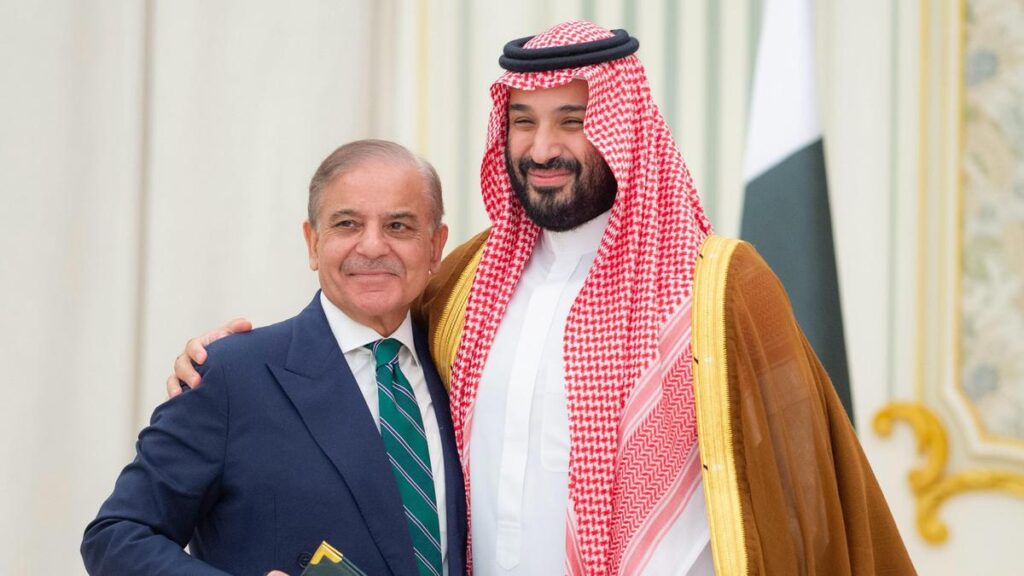
The Deal That Changes Everything: The SMDA
At the heart of this tension is a treaty that most Pakistanis have never read and that was never presented to parliament.
Pakistan signed a Strategic Mutual Defence Agreement with Saudi Arabia on September 17, 2025, during a visit by Prime Minister Shehbaz Sharif to Riyadh where he met Saudi Crown Prince Mohammed bin Salman. International Monetary Fund
The agreement stipulates that any aggression against the Kingdom will be considered an aggression against Pakistan. A mutual defense pact formalized the countries’ security partnership in language that commits each country to treat an attack on the other as an attack on itself. Wikipedia
The details of the Pakistan-Saudi Arabia defence agreement have never been made public or even reviewed by Pakistan’s parliament. Secret documents obtained by investigative journalists reveal the extent to which Pakistan is committed by treaty to potentially become a participant in the very war it was attempting to mediate. International Monetary Fund
The leaked documents revealed something even more sensitive: internal debates within Pakistan’s military establishment about how far this commitment actually goes. Assessments noted the agreement did not clearly differentiate between conventional and nuclear forces, and the Pakistani military was only interested in committing conventional forces to any deal with Saudi Arabia, seeking to explicitly exclude nuclear capability from the obligation. Internal debates also noted that threats to Saudi sovereignty and interests might not remain confined within Saudi territory, and could require military action outside Saudi Arabia. International Monetary Fund
Although Pakistan’s Minister of Defence implied that the pact entailed a nuclear commitment to Saudi Arabia, he quickly reneged, denying that the agreement required Pakistan to use nuclear weapons in the defence of Saudi Arabia. Analysts find it highly unlikely that Pakistan would use nuclear weapons to repel attacks on Saudi Arabia — the Pakistani nuclear capability exists to deter its chief adversary, India. geo
Pakistan Tells Iran — Openly — About the Saudi Pact
In a remarkable diplomatic moment that speaks to the complexity of Pakistan’s position, Islamabad chose transparency over ambiguity when it came to Iran. Rather than quietly honouring the Saudi commitment while hoping Tehran wouldn’t notice, Pakistan’s foreign minister told Iran directly.
Addressing the Senate on March 3, three days after the war began, Foreign Minister Ishaq Dar said plainly that Pakistan had a defence pact with Saudi Arabia “and the whole world knows about it.” He added that he had personally conveyed Pakistan’s obligations under the pact to Iranian Foreign Minister Abbas Araghchi, making clear what the agreement entailed. Prime Minister Sharif similarly pledged that Pakistan would stand by the kingdom and its people. Business Recorder
Pakistan will stand with Saudi Arabia under its defence pact with the kingdom if the Iran war escalates, a Pakistani security official confirmed. The Pakistani military condemned Iran’s continued attacks on Saudi Arabia, describing them as an escalation that undermines peace efforts, while stating that Saudi Arabia’s “patience and restraint,” despite Iranian “provocations,” had kept the door open for mediation, and warning that continued attacks would risk closing that door. dawn
This is an extraordinary diplomatic posture: Pakistan is simultaneously telling Iran “we will defend Saudi Arabia if you attack it” and telling the world “we are the only neutral party Iran trusts enough to mediate.” The fact that these two positions haven’t yet collapsed into contradiction is itself a testament to the credibility Pakistan has built with Tehran over years.
The Fighter Jets That Launched While Talks Were Happening
The deployment of Pakistani fighter jets to Saudi Arabia on April 11 — the same day as the Islamabad Talks — was deliberately calibrated, according to analysts. But it was also diplomatically explosive.
As the jets touched down in the kingdom, Pakistan was hosting direct negotiations between the United States and Iran in Islamabad, with senior delegations from both sides at the table and Pakistani mediators in the room, working on ending the weeks-long war. Profit by Pakistan Today
Analysts who spoke to Al Jazeera offered competing interpretations of what this move actually meant. Islamabad-based security analyst Imtiaz Gul told Al Jazeera the deployment was not a military escalation, but an attempt to communicate Pakistan’s commitments to Iran. “Three jets won’t make much of a difference militarily,” he said, given the scale of Saudi Arabia’s own air force. “It’s messaging Tehran to be flexible in these talks, but also it is underlining to them that Pakistan has obligations under the mutual strategic agreement it has with Riyadh.” Profit by Pakistan Today
Michael Kugelman, a resident senior fellow for South Asia at the Atlantic Council, told Al Jazeera that Pakistan’s move was “a bit of a risky gambit.” He said: “This is Pakistan signalling to Iran that if Iran is not willing to make the types of concessions that lead to a deal and the conflict resumes and escalates, there is a chance that Pakistan could move itself closer to Saudi Arabia and conceivably invoke the mutual defence pact.” Profit by Pakistan Today
In other words: the fighter jet deployment was a message, not a military escalation. The message to Tehran was: make a deal now, while Pakistan is still your mediator. Wait too long, and the calculus may shift.
What Pakistan Stands to Lose If the Balancing Act Fails
Pakistan’s motivations for maintaining this impossible balance are not purely altruistic. The country has deeply concrete interests on both sides of this conflict that explain why it has no choice but to try.
The Saudi Connection — Money, Remittances, and History
Pakistan relies heavily on financial support from Saudi Arabia. Remittances from millions of Pakistani workers in Saudi Arabia and other Gulf states represent one of the country’s most important sources of foreign exchange. Wikipedia
Remittances from millions of Pakistani workers in Saudi Arabia and other Gulf states were at risk if the relationship deteriorated — a risk Pakistan’s economy, already under severe strain from the energy crisis triggered by the conflict, could not absorb. International Monetary Fund
Saudi Arabia also holds a unique historical place in Pakistan’s strategic framework. Since the 1980s, Pakistan has deployed troops on Saudi soil in various capacities — a relationship rooted in deep religious, financial, and strategic ties that no Pakistani government can afford to rupture.
The Iran Connection — A 900km Border and a Shia Population
Pakistan shares a 900-kilometer border with Iran and has a domestic Shia Muslim population estimated at 15–20% of the country’s total. Following Khamenei’s killing on February 28, protests erupted across Pakistan, particularly among the Shia community. In Karachi, protesters attempted to storm the US Consulate. At least 10 people were killed and more than 60 were injured when US Marine security guards opened fire. At least 23 protesters were killed in clashes across the country by early March, with a three-day curfew imposed in Gilgit-Baltistan. International Monetary Fund
As the country with the largest Shi’ite Muslim population after Iran, Pakistan also has domestic motives to push for a ceasefire between the US and Iran. This makes a deterioration in Pakistan-Iran relations a genuine domestic security risk, not just a foreign policy problem. Wikipedia
The US Connection — Leverage and IMF Lifelines
Pakistan enjoys good ties with both Iran and the US. A phone call between President Trump and Pakistan’s Army Chief further affirmed Pakistan as a go-between conveying US demands to Iran, with the US leader commenting that Pakistan knew Iran well. Wikipedia
The US connection also matters economically. Pakistan’s $7 billion IMF program — the lifeline keeping the country’s finances stable — requires continued US support within the fund’s executive board. Losing American goodwill would be a catastrophic economic risk.
The IRGC Problem: The Gap in Pakistan’s Mediation
There is one critical vulnerability in Pakistan’s mediation capacity that analysts at the Stimson Center have highlighted — and it goes to the heart of why getting a deal done is so difficult.
Pakistani officials have struggled to develop a direct channel of communication with the powerful Islamic Revolutionary Guards Corps (IRGC), which, especially after the assassination of Khamenei, is considered to be the main entity at the helm of Iranian decision-making. Pakistani decision makers have mainly engaged with Iran’s President Masoud Pezeshkian and Foreign Minister Abbas Araghchi — the civilian diplomatic track — during the recent diplomatic efforts. Wikipedia
Within Pakistan’s strategic circles, it is generally understood that the January 2024 Iranian missile strikes on Pakistan were sanctioned by IRGC leaders, not the Iranian civilian government. The Pakistani military was particularly perturbed by Iranian attacks on Saudi Arabia’s Jubail Petrochemical Complex and feared it was a last-ditch attempt to derail talks. Wikipedia
This is the central structural weakness of Pakistan’s mediation position. The people Pakistan talks to in Tehran — the president, the foreign minister, the parliamentary speaker — are not the people who ultimately decide whether Iran fires missiles at Saudi Arabia or reaches a deal with the United States. That power sits with the IRGC, and Pakistan has not yet found a reliable channel into that institution.
The Red Line: Defensive vs. Offensive Operations
Military analysts are drawing a very clear line between what Pakistan can and cannot do while maintaining its mediator role.
A former three-star Pakistani general cautioned that Pakistan’s window for playing the role of both mediator and Saudi military ally was narrow. “Pakistan can hold both roles only if any military deployment remains strictly defensive, time-bound, and transparently limited. The moment the theatre shifts to offensive operations, or the perception of offensive coordination emerges, the dual role collapses,” he said, speaking on condition of anonymity. Business Recorder
He pointed to the long history of Pakistani deployments in Saudi Arabia as a factor that could shape Iran’s response. “Iran’s perception, not Pakistan’s intent, will determine whether trust survives,” he said. Business Recorder
This distinction — defensive vs. offensive — is the razor’s edge Pakistan is walking. Deploying a handful of fighter jets to a Saudi air base for defensive air cover is qualitatively different from committing to offensive strikes against Iranian targets. Iran, for now, appears to be accepting Pakistan’s framing of the deployment as defensive and limited. But that acceptance is fragile and conditional — and the IRGC, which operates by its own calculus, may not share the civilian government’s tolerance.
What Would Make the Balancing Act Collapse?
Analysts and Pakistani officials themselves have identified the scenarios that could bring this whole structure down.
The most dangerous scenario is a fresh Iranian missile or drone attack on Saudi Arabia’s critical infrastructure — particularly the kind of strike that causes mass casualties or major economic damage. If that happens, Riyadh would expect Pakistan to actively contribute to its defense under their security agreement, as analysts and Pakistani officials have acknowledged. At that point, Pakistan would face a binary choice between its treaty obligations to Saudi Arabia and its role as a neutral mediator — and it could not honour both simultaneously. dawn
The SMDA represents a commitment from Pakistan to militarily assist a key ally that was repeatedly hit by Iran before the ceasefire — with Tehran offering no guarantees it will not strike Saudi Arabia or other Gulf nations again. Business Recorder
A second risk is domestic. Pakistan’s Shia community and pro-Iran factions are already pushing back hard against the government’s posture. In a late March meeting with prominent Shia clerics who had expressed concerns about the war, Army Chief Asim Munir reportedly told those assembled, “If you love Iran, go to Iran.” Syed Ahmad Iqbal Rizvi, deputy head of the Muslim Unity Movement, an umbrella body for Shia parties, pushed back in a recorded statement: “We boldly respond to the army chief’s remarks — we love our country, but this war is between right and wrong. We stand with the right, with Iran.” International Monetary Fund
A third risk is the nuclear ambiguity. While Pakistani officials have denied any nuclear commitment to Saudi Arabia, the leaked SMDA documents and the original public statements from Pakistan’s Defence Minister created enough ambiguity to generate genuine concern. If Saudi Arabia were to face an existential threat, the pressure on Pakistan to escalate its response beyond conventional forces would be enormous — even if every Pakistani official today insists that nuclear deployment on Saudi Arabia’s behalf is unthinkable. geo
The Case for Optimism: Why Pakistan Might Actually Succeed
Despite all these risks, there are genuine reasons to believe Pakistan can thread this needle — at least long enough to get a deal done.
Pakistan’s unique position as a country that had the necessary connections within Washington, Tehran, and Riyadh to act as an intermediary is something no other state in the world currently possesses in the same combination. Pakistan is the only regional state to have condemned the attacks against Iran while simultaneously maintaining an active defence partnership with Saudi Arabia and a strong security relationship with the United States. Wikipedia
Pakistan offered to host mediation talks and presented itself as a potential bridge between the parties. Defence Minister Khawaja Asif had previously stressed the importance of the US relationship but ruled out military participation in any campaign against Iran. PM Sharif has repeatedly called for an immediate reduction in hostilities in Iran and the Gulf region. International Monetary Fund
The recent engagement between Pakistan and China and their March 31 joint statement proposing a five-point plan to end the war on Iran recognised Pakistan’s limitations as a mediator and the need for a major global actor to underpin its diplomatic efforts — suggesting that Islamabad is being realistic about what it can achieve alone and is already building a coalition of support. Wikipedia
Iran itself has given Pakistan perhaps its clearest vote of confidence. As Iranian Ambassador to Pakistan Reza Moghadam stated, Tehran would do talks “in Pakistan and nowhere else, because we trust Pakistan” — a statement of confidence in Islamabad’s neutrality that has not wavered despite the Saudi deployment.
The Bigger Strategic Bet
Ultimately, Pakistan’s approach to this crisis reflects a strategic calculation that has been building for years: that Islamabad’s greatest source of international leverage is its unique ability to talk to everyone simultaneously — the US, China, Saudi Arabia, and Iran — without being formally aligned with any one camp in ways that would permanently exclude it from the others.
Pakistan, which shares a 900-kilometer border with Iran and has close ties with both Iran and Saudi Arabia, has condemned attacks by all sides while engaging in shuttle diplomacy — simultaneously fighting Afghanistan, managing domestic protests, and dealing with an energy crisis linked to the conflict. International Monetary Fund
The answer to whether Pakistan can juggle both roles is: probably yes, for now — but only within a narrow and rapidly closing window. If a deal is reached before the ceasefire collapses entirely, Pakistan’s balancing act will be remembered as one of the most remarkable diplomatic achievements of the 21st century. If the conflict resumes in full force and Saudi Arabia is struck again, Pakistan may find that holding two incompatible commitments at once was always more of a gamble than a strategy.
The next few weeks will determine which verdict history delivers.
Pakistan’s Strategic Position at a Glance
| Relationship | Nature of Ties | Current Role | Risk Level |
|---|---|---|---|
| United States | Major Non-NATO Ally, IMF dependency, security partner | Conveying US demands to Iran, hosting talks | Medium — Trump’s unpredictability |
| Iran | 900km shared border, Shia population ties, historic diplomacy | Primary mediator, shuttle diplomat | High — IRGC mistrust |
| Saudi Arabia | SMDA defence pact, remittances, decades of military deployments | Active military partner, PAF jets deployed | Very High — treaty obligations |
| China | CPEC, strategic partnership | Co-author of 5-point peace plan | Low — supportive |
For in-depth coverage of Pakistan’s diplomacy, economy, and regional affairs, visit FQF World.
External Sources: Al Jazeera | Stimson Center | Georgetown Journal of International Affairs | Drop Site News | UK House of Commons Library | Wikipedia — Islamabad Talks