




As US diplomats boarded planes headed to Islamabad for a second round of peace talks, Iranian President Masoud Pezeshkian fired back at Washington with his most direct statement yet on the nuclear question. His message was blunt, defiant, and leaves little room for misreading: Iran is not surrendering its nuclear program, and no American president has the authority to demand it.
Pezeshkian’s Words — Direct and Unambiguous
Speaking on Sunday in Tehran, President Pezeshkian did not deliver diplomatic language carefully crafted for back-channel consumption. He spoke plainly, and the world was meant to hear it.
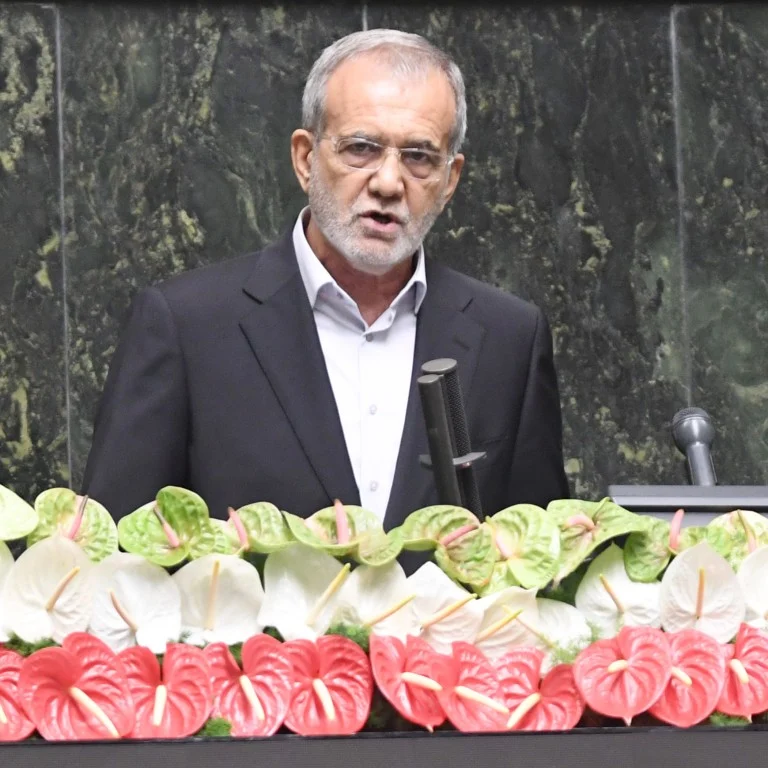
“Trump says Iran cannot make use of its nuclear rights, but doesn’t say for what crime. Who is he to deprive a nation of its rights?” the Iranian President stated directly. ANI News
Pezeshkian criticized Trump’s remarks on Iran’s nuclear programme, stressing that no world leader has the authority to strip a sovereign nation of its rights or restrict its access to peaceful nuclear energy. He argued that such positions contradict international principles and undermine state sovereignty. BOL News
Pezeshkian questioned Trump’s authority to restrict Iran’s nuclear activities, asking what “crime” Iran had committed to justify such demands. He reiterated Iran’s long-standing position that its nuclear programme is peaceful and meant for civilian purposes. ProPakistani
These are not the words of a government preparing to capitulate. They are the words of a president speaking to his own people as much as to Washington — signalling that whatever happens in Islamabad, Iran’s nuclear identity is not on the table.
Iran Also Rejects Sending Enriched Uranium to the US
Beyond the political statement, Iran has also specifically rejected one of the most concrete US demands on the table — the transfer of its enriched uranium stockpile abroad.
President Trump had claimed on April 16 that Iran had agreed to hand over its entire stockpile of enriched uranium — referred to by him as “nuclear dust” — without compensation as part of a broader peace deal. He described the negotiations as “100% complete” on key elements. Life News Agency
Tehran’s response was swift and unambiguous. Iranian officials described the option of shipping enriched uranium overseas as “unacceptable” and stated that Trump’s claims “do not reflect the reality of the negotiations.” Life News Agency
Deputy Foreign Minister Saeed Khatibzadeh clarified that no enriched material would be shipped to the US, underscoring the “fundamental issues” that still need to be resolved before a permanent peace deal can be reached. News.az
That is a direct contradiction of what Trump told the American public. One side is describing a deal nearly done. The other side is saying it never agreed to the most important part.
What Exactly Does the US Want?
To understand why this dispute is so fundamental, it helps to know what Washington is actually asking for — because the demands go well beyond a simple “don’t build a bomb” pledge.
The US has insisted that Iran agree to a permanent ban on enrichment. During the Islamabad talks, US negotiators reportedly proposed a 20-year moratorium on Iran’s uranium enrichment — a key process for producing nuclear weapons fuel. Iran countered with a five-year enrichment moratorium, which Washington rejected. FDD
Other key US demands during the talks included Iran surrendering its existing stockpile of enriched uranium — including roughly 440 kilograms of highly enriched uranium — and fully dismantling the enrichment facilities struck by US forces in June 2025 at Natanz, Isfahan, and Fordow. Washington also insisted on intrusive inspections, including full and restored access for the International Atomic Energy Agency, and a formal renunciation of nuclear weapons development. FDD
Iran’s position, by contrast, is that enrichment is a sovereign right under international law. It points to the Non-Proliferation Treaty and decades of peaceful nuclear development as justification. To Tehran, what the US is asking is not disarmament — it is the destruction of Iran’s entire scientific and industrial nuclear infrastructure.
The 2015 Deal — The Ghost at the Table
No discussion of this standoff makes sense without understanding what happened to the last major nuclear agreement. The 2015 Joint Comprehensive Plan of Action — the Iran nuclear deal — was the product of years of painstaking multilateral diplomacy. It was not perfect, but it worked.
The dispute over Iran’s nuclear programme dates back more than two decades and intensified after the United States withdrew from the 2015 nuclear agreement during Trump’s earlier presidency. Since then, negotiations to revive or replace the deal have repeatedly faltered. Western governments accuse Iran of advancing uranium enrichment beyond agreed limits, while Iran insists enrichment is its sovereign right under international law for energy production, medical research, and technological development. ProPakistani
When the US walked away from that deal in 2018, Iran gradually resumed and then expanded its enrichment programme. By 2026, its stockpile of highly enriched uranium had grown to levels never seen before the original agreement. Ironically, the US decision to abandon the deal that constrained Iran’s nuclear activities is a major reason why those activities are now so much harder to roll back.
Pezeshkian: Iran Seeks Peace — But Not Surrender
The Iranian president was careful to frame his country’s position as defensive rather than aggressive — a distinction that matters enormously in the diplomatic context.
Pezeshkian reaffirmed that Iran’s political and security doctrine is based on “maintaining peace, stability, and security in the region.” He clarified that his country “does not seek to expand the circle of war, has not initiated any historical conflicts,” and does not intend to attack any country. Voice Of Emirates
“Despite the expert understandings reached between the parties, the excessiveness and lack of political will of senior US officials have prevented the agreement from being finalized,” Pezeshkian stated. He made clear that “approaches based on threats, pressure, and military action not only do not solve the problem, but also add to the complexity of the issues.” Global Security
He further stated that Iran does not want to escalate the war and seeks to end it “with dignity.” “We did not start wars or conflicts. We do not intend to attack any country,” he said, reiterating Iran’s right to defend itself. Capitalnewspoint
The phrase “with dignity” is doing heavy lifting in Tehran’s diplomatic vocabulary right now. It signals that Iran will negotiate, but it will not be seen — domestically or internationally — as having been defeated. Any deal that looks like capitulation is a deal that cannot survive Iranian domestic politics.
The Ceasefire Is Expiring — and Talks Are Still Uncertain
All of this is happening as the two-week ceasefire brokered by Pakistan on April 8 ticks toward its Tuesday expiration date. Representatives of both countries are now highly likely to meet in Islamabad as local agencies ramped up efforts to increase security, suspend public transport and close areas of business. Foreign delegations have already started arriving at Nur Khan Airbase in Chaklala, Rawalpindi. ProPakistani
The question now is whether both sides can find enough common ground on the nuclear issue to prevent the ceasefire from expiring into renewed war. Based on the public positions of both parties, the gap is enormous. The US wants a permanent end to enrichment. Iran considers enrichment a non-negotiable sovereign right. Those are not positions that narrow easily in a single day of negotiations.
And yet — both sides are heading to the same city, at the same time, with the same mediator who pulled off the impossible once before. Whether Pakistan can do it again, in even more difficult circumstances, may be the most consequential diplomatic question of 2026.
External Sources: