

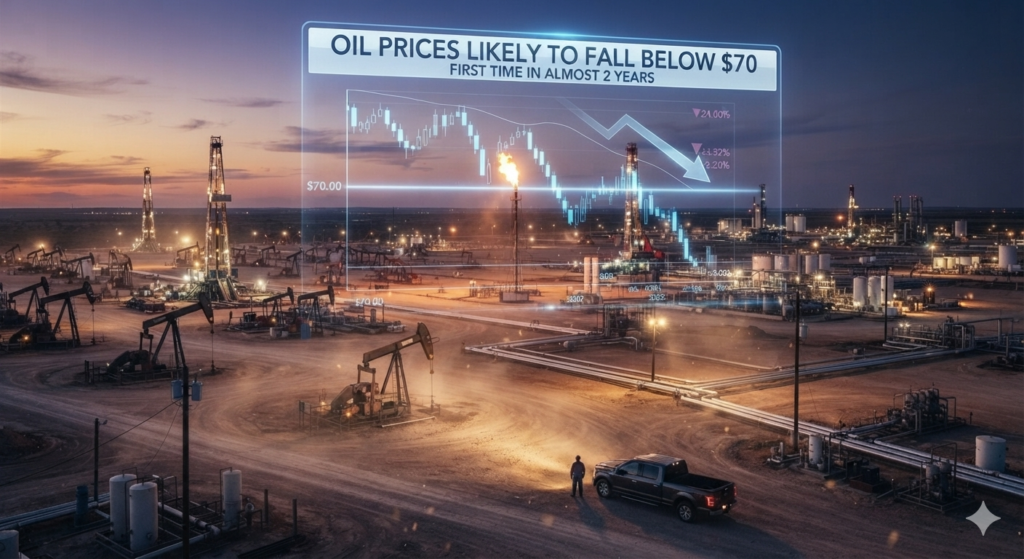
A month ago, oil was trading above $106 a barrel. Today, it’s around $79. That’s a 25% drop in roughly four weeks, which is the kind of move that normally takes a recession, not a single month.
Brent crude sat at $79.25 per barrel as of Monday, June 22, 2026, down sharply from the war-driven spike of last month but still meaningfully above the symbolic $70 mark that traders, drivers, and finance ministries everywhere are watching closely. In our analysis, the real story right now isn’t whether oil has already broken below $70. It hasn’t. The more interesting question is whether it’s about to, and what that would actually mean if it does.
Why Oil Spiked in the First Place
To understand the current slide, you need the full arc of what happened before it.
On February 28, 2026, Israel and the United States launched a joint military campaign against Iran. The conflict escalated quickly, and Iran responded by closing the Strait of Hormuz, the narrow waterway through which roughly a fifth of the world’s traded oil normally passes. Middle East producers were forced to cut output by more than 11 million barrels per day at the conflict’s peak, an extraordinary supply shock by any historical measure.
Brent crude reacted exactly as you’d expect, climbing to nearly $120 a barrel in the early weeks of the war, a four-year high. From there, prices stayed elevated for months as the conflict dragged on and the Strait remained largely closed to shipping.
The de-escalation that’s driven the recent slide has come in stages:
- April 11-12: The first direct, in-person US-Iran talks since 1979 took place in Islamabad, mediated by Pakistan
- June 12: The US and Iran reached agreed-upon text for a framework deal
- June 17-18: The Islamabad Memorandum of Understanding was signed, calling for reopening the Strait of Hormuz and a 60-day ceasefire extension
- June 21-22: Follow-up talks in Switzerland produced a 60-day roadmap toward a final agreement, with the US Treasury authorizing the sale of Iranian oil for 60 days
When looking closely at the data, the market’s reaction has tracked this diplomatic timeline almost exactly. Each de-escalation milestone has corresponded with a fresh leg down in price, which tells you the war premium, not underlying supply-demand fundamentals, was doing most of the work in keeping oil above $100.
So How Close Is $70, Really?
This is where some recent coverage has overstated the case. Oil is not below $70 yet, and it hasn’t been for some time. But the gap has closed considerably, and the forces pushing it lower are real.
What’s actually pulling prices down right now:
- Shipping activity through the Strait of Hormuz has picked back up, with millions of barrels reportedly transiting the chokepoint over the past weekend
- Iran has increased visible oil shipments through Hormuz to the highest level since the conflict began, including discounted cargoes sold to China
- Gulf producers are moving to restore output — Kuwait has lifted force majeure notices, and Abu Dhabi’s ADNOC has resumed supply operations
- A full reopening of Hormuz could release roughly 80 million barrels into the market, according to industry estimates, at a moment when global demand remains soft
That last point is the one worth sitting with. Even setting aside the war entirely, global oil markets were already leaning toward oversupply going into 2026. The International Energy Agency has forecast that supply growth could outstrip demand by close to 4.7 million barrels per day once Hormuz traffic normalizes, which is the kind of imbalance that historically pushes prices down, not just back to where they started.
The Case for Oil Actually Reaching $70 or Lower
It’s a reasonable industry expectation, not a certainty, that oil drifts meaningfully lower from here, though forecasters disagree sharply on timing and depth.
Arguments for a continued slide toward or below $70:
- The EIA’s own pre-conflict forecasts from earlier in 2025 had already projected Brent averaging in the high-$50s to $60s through 2026, driven by oversupply independent of any Middle East disruption
- J.P. Morgan’s research team has projected Brent averaging around $60 per barrel in 2026 based on soft underlying fundamentals
- Brent actually spent meaningful stretches of 2025 below $70 already — it averaged $67 in August and $68 in September of last year, well before this year’s conflict even began, showing the price has sat near or under this level fairly recently
- China’s strategic stockpiling, which has been absorbing excess supply, could plateau or slow, removing a demand cushion that’s propped up prices
Arguments for prices staying elevated longer than headlines suggest:
- The EIA’s June 2026 outlook projected Brent averaging around $105 in June and July specifically because of the lingering physical disruption from production shut-ins, which can’t be reversed overnight even once a diplomatic deal is signed
- Restarting more than 11 million barrels per day of shut-in Middle East production is a genuinely complex, multi-week engineering process, not a switch that flips the moment a ceasefire holds
- Global oil inventories have been drawn down to multi-year lows during the conflict, meaning the market needs to rebuild stockpiles before supply truly outpaces demand again
- The Islamabad Memorandum is explicitly a framework, not a final settlement, and the 60-day negotiating window could still collapse if talks on Iran’s nuclear program break down
That EIA $105 average projection sits oddly next to today’s $79 spot price, and it’s worth being upfront about that tension rather than picking whichever number supports a cleaner narrative. Short-term spot prices and quarterly average forecasts can diverge significantly, especially during a fast-moving de-escalation, and the EIA’s own forecast was completed on June 4, before some of the more recent diplomatic progress.
Why “Two Years” Doesn’t Quite Hold Up as a Framing
It’s worth directly addressing a framing that’s circulated in some coverage: that oil falling below $70 would mark the first time in almost two years.
That doesn’t match the available pricing history. Brent crude spent real, sustained stretches of 2025 trading in the high-$60s, including monthly averages of $67 and $68 in August and September. The full-year 2025 average came in at $69.14, meaning oil was at or below the $70 threshold for a meaningful share of last year, not absent from that territory since 2024.
If oil does fall below $70 in the coming weeks, the more accurate framing is that it would be returning to levels last seen less than a year ago, following an unusually sharp, war-driven detour back above $100. That’s a less dramatic headline, but it’s the one the data actually supports.
Specialist’s Insight: What a Sub-$70 Oil Price Would Actually Mean
From a journalistic viewpoint, the more useful conversation isn’t really about hitting a round number. It’s about what that price level means for different groups, because the effects aren’t uniformly good or bad.
Who benefits from oil sliding toward $70:
- Consumers, through lower gasoline and diesel prices, with the EIA noting retail fuel costs typically follow crude prices down, albeit with a lag
- Countries that import most of their oil, including much of Europe and Asia, who saw energy costs spike sharply during the conflict
- Central banks managing inflation, since elevated energy costs were a meaningful contributor to price pressures during the war months
Who faces real strain if prices keep falling:
- US shale producers, many of whose breakeven costs for new drilling sit in the $61 to $70 per barrel range, meaning a sustained drop below $70 could trigger pullbacks in drilling activity
- Gulf oil exporters like Saudi Arabia, who rely heavily on oil revenue to fund economic diversification projects such as Vision 2030
- Russia, already operating under sanctions on a majority of its crude exports, facing a tougher fiscal picture if global benchmark prices fall further
None of this makes a lower oil price simply good or bad in some absolute sense. It’s a genuine trade-off between consumer relief and producer strain, and which side of that trade-off matters more depends entirely on where you sit in the global economy.
What to Actually Watch From Here
Rather than fixating on whether oil crosses exactly $70, the more informative signals are the ones driving the underlying trend: whether Hormuz shipping volumes continue climbing back toward pre-conflict levels, whether the 60-day US-Iran negotiating window set in Switzerland produces a durable final agreement rather than stalling, and whether China’s strategic stockpiling pace holds steady or slows.
If those three things keep moving in the direction they have over the past week, a sub-$70 print becomes a question of when, not if. If any of them reverses, particularly a breakdown in the broader US-Iran negotiations, the current slide could stall well above that threshold instead.